
REVIEW · SELF-GUIDED TOURS
Explore Copenhagen: Self-Guided Audio Tour
Seven stops, one easy Copenhagen route.
This self-guided audio tour strings together major sights you can actually walk between, then gives you the story behind the brick, domes, observatories, and palaces. I like that it is set up for a 2 to 3 hour wander, not a rushed sprint, and it works for most people at a moderate pace.
Two things I especially like: first, you get audio files and GPS map support with the route, so you are not stuck staring at street corners. Second, the stop details are specific, like Bishop Absalon’s gilded statue at City Hall and the Round Tower’s spiral ramp to the top.
One consideration: the experience depends on your phone and your audio setup. If your speaker is weak, or you have trouble hearing over city noise, you might find the sound effects and background can make the narration harder to catch, especially at higher volume.
In This Review
- Quick hits before you press play
- Price and value: what $15.29 buys in the real world
- Prep: how to make the tour work smoothly
- City Hall Square and Bishop Absalon’s golden presence
- The Round Tower ramp spiral and the 1657 library story
- Rosenborg Castle and Christian IV’s Dutch Renaissance look
- Frederiks Kirke (Marmorkirken) and Scandinavia’s largest dome
- Amalienborg Palace and the octagonal royal rebuild
- Royal Danish Theatre Play House and the French-comedy beginning
- Christiansborg Palace Royal Kitchens: Blue Tower and Leonora Christina
- Timing, comfort, and who should choose this walk
- Should you book this self-guided Copenhagen audio tour?
- FAQ
- Is this audio tour available in English?
- How long does the self-guided tour take?
- Where do I start and where can I finish?
- Do the ticket price and audio include admission to the attractions?
- Do I need to download anything before I start?
- Do I need an audio device provided by the tour?
Quick hits before you press play
- Download-first setup: get the tour ready ahead of time so you can follow directions without stress.
- A map that helps you navigate: the package includes a map, plus audio directions to each stop.
- Short, manageable stops: plan about 15 minutes per landmark for a smooth flow.
- Real architectural and historical hooks: each stop connects to a clear theme, from observatory design to royal rebuilding.
- You control the pace: self-paced means you can linger if a facade pulls you in.
- Audio quality is the wildcard: you might want headphones just in case.
Price and value: what $15.29 buys in the real world
At $15.29 per person, you are paying for the structure. You get audio files plus a GPS map, all in English, designed to link seven major sights into a coherent walk. That is the value piece: you are not paying for a guide’s time, so your “cost” becomes your setup time (download, then listen).
What you do not get is the hard stuff that can inflate other tours. Admission fees are not included, and there is no physical guide or dedicated audio device. In practice, this can still be a good deal if you are comfortable using your own phone for audio and you are happy with outside viewing for places that might charge for entry.
Also, the tour is capped at 50 travelers. For a self-guided route, that mostly signals limited availability of the packaged experience, not a crowded meeting scene. You still get the benefit of knowing the route was built for a real group size, not a random free-for-all.
More of Copenhagen, reviewed one tour at a time
- Copenhagen: Canal Cruise with Guide
★ 4.6 · 9,115 reviews - Copenhagen: Hop-On Hop-Off Bus Tour with Boat Tour Option
★ 3.9 · 4,122 reviews - Private Walking Grand Tour of Copenhagen
★ 5.0 · 3,953 reviews - From Copenhagen: Lund and Malmö 2-Country Tour
★ 4.7 · 2,772 reviews
Prep: how to make the tour work smoothly
Do the setup before you start walking. The tour instructions tell you to download the audio file ahead of time, and one review also describes a zip file on your phone that contains the map plus the audio tracks.
Here is the practical rhythm that tends to work:
- Download and extract the files first, ideally on Wi-Fi.
- Check that you can open the map and play the tracks.
- Bring a small power boost if you know you use your phone hard for navigation and audio.
- If sound is a concern, use headphones. Even basic earbuds can be the difference between understanding every word and guessing.
If you find the narration is hard to hear, do not just soldier on. This kind of audio-based tour lives or dies by clarity.
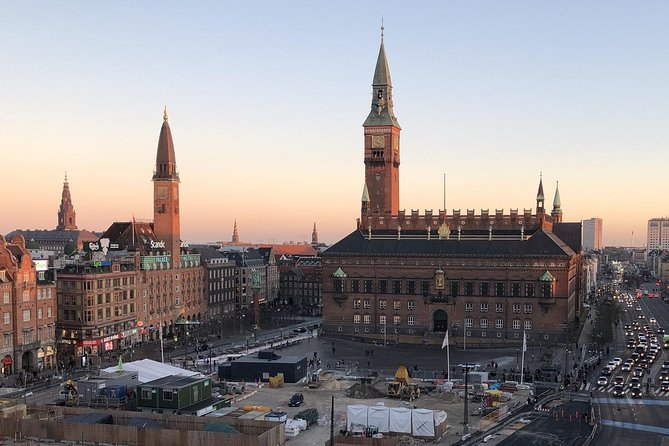
City Hall Square and Bishop Absalon’s golden presence
Start at Rådhuspladsen 1599 Copenhagen. This area gives you a strong “Copenhagen center” feel fast, and the first stop is one of the most recognizable landmarks in town.
At Copenhagen City Hall, you are looking for three things as you listen:
- The ornate brick facade
- The clock tower
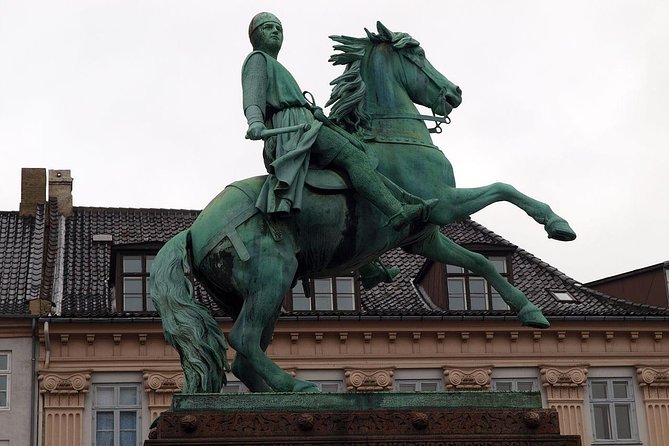
- The gilded statue of the city founder, Bishop Absalon, above the front balcony
The building is in the National Romantic style, which was popularized by architect Martin Nyrop. The tour’s connection to inspiration is useful too, because you are not only seeing a pretty facade, you are learning what designers were borrowing and adapting. The City Hall is inspired by the City Hall in Siena, Italy, which gives you a nice mental cross-compare if you have ever visited Siena.
Timing tip: plan about 15 minutes here. If you linger too long, the rest of the loop will start to feel like a chase, not a stroll.
The Round Tower ramp spiral and the 1657 library story
Next up is The Round Tower, part of the Trinitatis Complex with Trinitatis Church and a neighboring academic library linked to Copenhagen University.
The big idea: this is a 17th century astronomical observatory. You might expect stairs. Instead, the tour points out the defining feature, a spiral ramp that spirals to the top. That design choice makes the structure feel more like a purpose-built machine than a sightseeing prop.
The story doesn’t stop at the tower. The library opened in 1657 and once housed the university’s entire collection, roughly 10,000 books. Even if you only take in the exterior or approach areas, this detail gives the place weight. It is not just “a tower you see in pictures,” it is a working academic space that shaped learning in the city.
Drawback to watch for: if you have limited mobility, any ramp or uneven ground can change your comfort level. The tour lists a moderate physical fitness level, so decide based on your own comfort with walking between stops.
Other trips with a guide along for it
- Copenhagen: Highlights 3 Hour Bike Tour with a Local Guide★ 4.8 · 2,312 reviews
- Copenhagen Sightseeing Classic Canal Tour With Live Guide★ 4.5 · 1,906 reviews
- Copenhagen: Guided Canal Tour by Electric Boat★ 4.8 · 1,341 reviews
- Copenhagen: 3-Hour City Highlights Bike Tour with Guide★ 4.7 · 1,239 reviews
- Copenhagen Highlights 3 Hour Bike Tour with local Guide★ 5.0 · 1,125 reviews
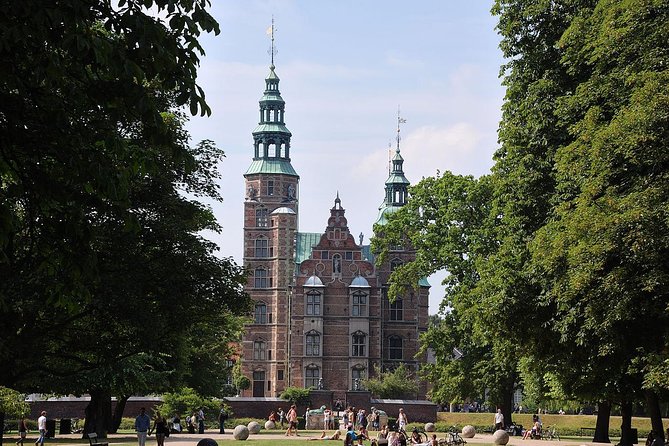
Rosenborg Castle and Christian IV’s Dutch Renaissance look
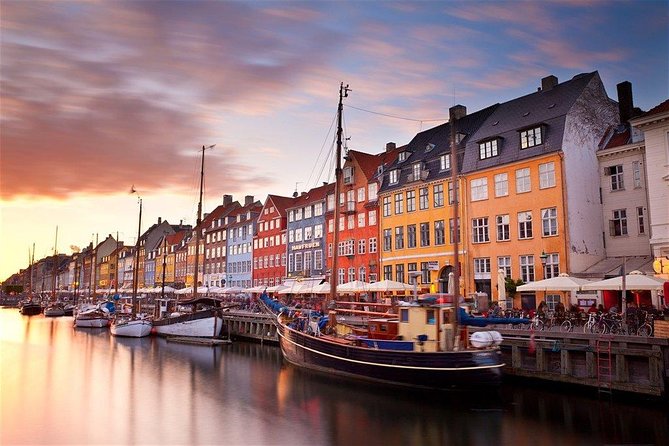
From there, head to Rosenborg Castle, tied to King Christian IV’s building projects. This is where the tour’s architectural descriptions pay off because the castle has a distinct visual language.
The key style note is Dutch Renaissance, with characteristics like high gables and spires. The date range matters too: it was commissioned by Christian IV, and even after completion it continued to be expanded until around 1624, when it reached something close to its current form.
What I like about this stop in an audio tour format is that it helps you look at the building like a set of choices, not just a backdrop. You learn what makes it feel Dutch Renaissance, then you can spot those features with your own eyes as the track plays.
Timing tip: keep it close to that 15 minute window unless you also plan to pay for interior access, which is not included in the tour price.
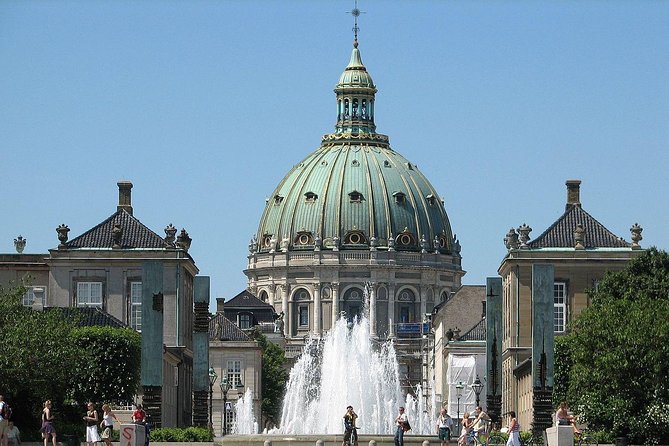
Frederiks Kirke (Marmorkirken) and Scandinavia’s largest dome
Now you get a big, dramatic moment: Frederiks Kirke, better known as Marmorkirken or Marble Church.
The tour highlights that it has the largest church dome in Scandinavia. Even if you are viewing from outside, the dome fact gives you a reason to step back, look up, and take it in from multiple angles.
There is also a planning story attached to it. In 1748, King Frederik began plans for a grand district called Frederiksstaden. That matters because it connects the church to the idea of a city shaping itself, not just a single building appearing out of nowhere. It is urban planning as background music.
Practical note: domes tend to reward patience. You might want an extra minute or two here if the wind or crowds make your first glance rushed.
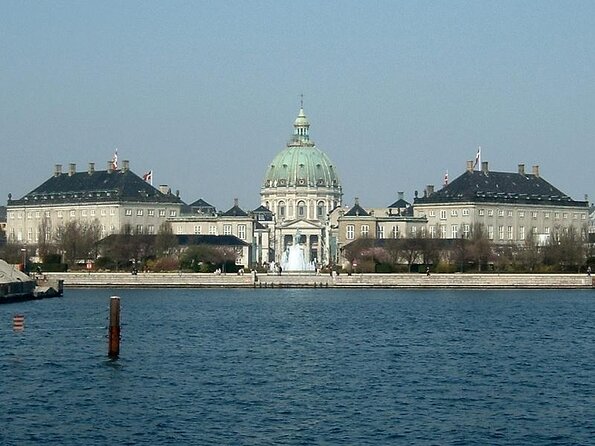
Amalienborg Palace and the octagonal royal rebuild
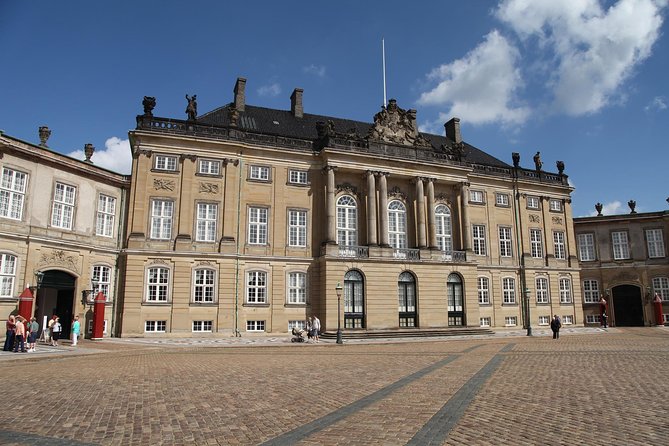
Next is Amalienborg, the current residence of the Danish royal family. This stop changes the mood from grand historic buildings to an active political and ceremonial center.
The tour gives you the origin story first: the first palace at the site was built between 1669 and 1673 by Queen Sophie Amalie, wife of King Frederik III. Then comes the twist that helps you understand why Amalienborg looks the way it does today.
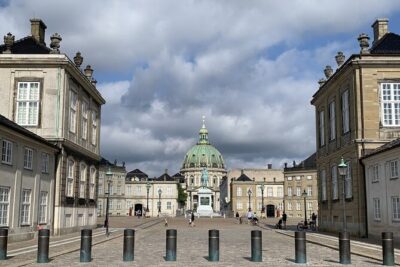
The current palace complex was designed as the crowning jewel of the Frederiksstaden district. King Frederik V dismantled the earlier palace and built the octagonal complex you see now.
I love learning these “why it looks like that” connections. Instead of calling the shapes fancy, you get the reason behind the form. It also makes the place feel more layered when you realize it was rebuilt rather than simply preserved.
Tip for your listening: let the audio finish the rebuild explanation before you walk away. It is the moment where the architecture turns into a story you can retell.
Royal Danish Theatre Play House and the French-comedy beginning
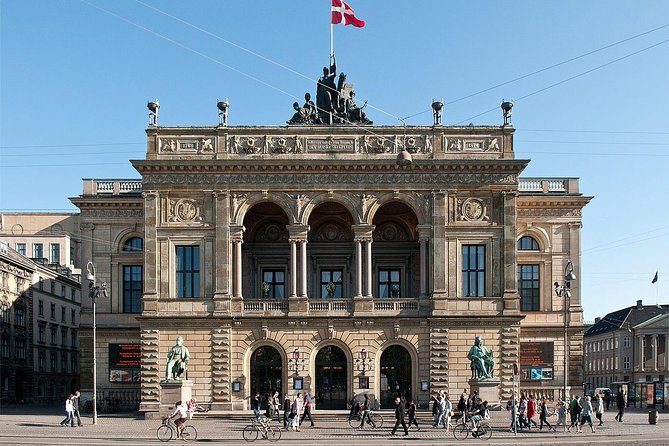
Then you arrive at the Royal Danish Theatre Play House. This stop is a reminder that cultural institutions in Copenhagen grew step-by-step, reacting to demand.
The first theatre on this location was built in 1748, seating 800 people. It employed eight actors and four actresses, and performances were mainly French comedies. That “mainly French comedies” detail is a great clue about the city’s cultural tastes at the time.
But it was too small, so in 1774 it was rebuilt for a larger audience. From there, the Royal Danish Theatre became home for performing arts, including ballet, opera, and the royal orchestra.
This is a good stop to listen with intent. If you look at the building as just another facade, you miss the theme. If you listen for how it grew, you start seeing the theatre as an evolving engine for the arts in Copenhagen.
Christiansborg Palace Royal Kitchens: Blue Tower and Leonora Christina
Your final big historical stop is the Royal Kitchens of Christiansborg Palace. This area sits over the remnants of four previous castles, which is a lot of layers for one spot.
The tour’s timeline is what makes it click:
- In 1167, Absalon constructed the first castle on the island.
- It stood for over 200 years.
- After Absalon’s castle was destroyed by the Hanseatic League, Copenhagen Castle was built over the ruins.
- That castle lasted for several hundred years and is best known for its Blue Tower.
The Blue Tower is where the personal story comes in. It held Leonora Christina, daughter of Christian IV, captive for almost 22 years.
Even if you are not going inside anywhere, these details make the site feel like Copenhagen’s memory bank. It is one of those places where you can understand why cities build up on the same ground: the geography and politics kept mattering long after the original structures disappeared.
Timing, comfort, and who should choose this walk
This audio route is designed for about 2 to 3 hours, with around 15 minutes at each stop. That pacing is ideal if you want a solid sightseeing hit without losing your whole day.
You also get a few useful comfort pointers from the tour info:
- Moderate physical fitness is recommended.
- It is near public transportation, which helps if you need to rejoin the route later.
- Service animals are allowed.
Since there is no transportation included, plan your own transit or walking time between stops. Copenhagen is a great walking city, but your exact route will depend on where you line up with the sights.
If you love history but do not want a museum ticket marathon, this works well because many of the stops can be appreciated from outside while you listen.
If you hate fiddly tech, you might find the prep part annoying. The tradeoff is that the route is built to be navigable and structured once you have downloaded the files.
Should you book this self-guided Copenhagen audio tour?
Book it if:
- You want a walkable route through major landmarks.
- You like learning in small chunks, as you stand in front of the building.
- You are okay with outside viewing and potentially buying admission separately for any sites you want to enter.
- You can handle a bit of setup time, like downloading the audio and map.
Skip it or treat it cautiously if:
- You know your phone audio struggles in noisy outdoor settings.
- You prefer a human guide for context and smoother storytelling.
- You dislike anything that requires downloading files before you start.
For me, the deciding factor is the balance. At this price, you are not paying for extras. You are paying for a route that helps you see the city in an order that makes sense, with details that turn landmarks into stories.
If you do book, bring headphones and do the download early. That small step is what separates an easy afternoon from a frustrating one.
FAQ
Is this audio tour available in English?
Yes. The tour is offered in English only.
How long does the self-guided tour take?
Plan about 2 to 3 hours total, with roughly 15 minutes at each stop.
Where do I start and where can I finish?
You can start at Rådhuspladsen, 1599 Copenhagen, Denmark, and end at Tivoli Gardens, Vesterbrogade 3, 1630 København V, Denmark. Because it is self-guided, you choose your own starting and ending according to your schedule.
Do the ticket price and audio include admission to the attractions?
No. Admission fees are not included, and you will need to arrange tickets separately if you want to enter specific sites.
Do I need to download anything before I start?
Yes. You should download the audio file ahead of time, and the tour notes that downloading instructions are in the Before You Go section of your ticket.
Do I need an audio device provided by the tour?
No. An audio device is not included, so you will need to use your own phone to play the audio.
More Tours Around Denmark




All Our Denmark Reviews

Copenhagen, Reviewed
Other Danish days out we have written up



Self-Guided Tours, compared.
 ★ 4.2Hop-On Hop-Off Bus Tour with Audio GuideFrom $36100 reviews
 ★ 4.0The Ancient Viking Stronghold of Aros: A Self-Guided Audio Tour in AarhusFrom $1136 reviews
 ★ 4.5Monstour: A Self-Guided Audio Tour of Danish Folk LegendsFrom $719 reviews
 ★ 4.5Ghosts of Aalborg: The Witch Trial Exploration GameFrom $1011 reviews
 ★ 4.0Copenhagen Self-Guided Murder Mystery Tour by the Round TowerFrom $2911 reviews
 ★ 5.0Copenhagen Christiania: Hidden Stories Self-Guided AdventureFrom $78 reviews
 ★ 4.5Copenhagen Royal Conspiracy Exploration Game and TourFrom $77 reviews
 ★ 4.5Copenhagen’s Royal History: A Self-Guided Walking TourFrom $97 reviews