
REVIEW · COPENHAGEN TOURS
Grand Tour of Copenhagen – The Little Mermaid to Royal Castle
Little Mermaid to royal palaces, in one smooth sweep. This guided loop strings together Copenhagen’s best-known sights, from the waterfront icon at low tide to the royal power core around Amalienborg and Christiansborg. You also move past a string of stops that range from classic landmarks to modern Copenhagen, all in one guided plan.
I love how the route feels unhurried for how much ground it covers, with time to actually learn instead of just staring out the window. I also love the storytelling style credited to guides like Christian and Peter, who made the quick tour feel clear and fun rather than rushed.
One drawback to consider is that this is a highlights tour, so a few stops are brief photo breaks. Also, the Little Mermaid sits on a rock that’s best when the water is low, so it helps to be aware of low-tide access.
In This Review
- Key highlights you will not want to miss
- Why the Little Mermaid to Royal Castle route feels efficient
- Price and timing: what your 2.5 hours costs, and why it can be good value
- How the tour keeps you comfortable and informed (van, audio guide, and small groups)
- Tivoli Gardens, sculpture museums, and Copenhagen’s plant-filled side
- Rosenborg Castle and the Little Mermaid: two icons, two different kinds of time
- Gefion Fountain, Amalienborg at midday, and the Marble Church dome
- Christiansborg, Thorvaldsen’s grave, Operaen photos, and Børsen dragons
- Christianshavn to Nyhavn: canals, Holmens Church, the Black Diamond, Langebro, and Andersen’s harbor
- Who should book this tour, and who should skip it
- FAQ
- How long is the Grand Tour of Copenhagen?
- What is the price per person?
- Is pickup available?
- What time and where does the tour start?
- How many people are in the group?
- What’s included in the tour price?
- Is lunch included?
- Do I need to print tickets?
- Which stops are part of the route?
- Can I cancel for free?
- Should you book this Copenhagen highlights tour?
Key highlights you will not want to miss
- Low-tide Little Mermaid: bronze sculpture on a granite rock you can only truly appreciate when the water level cooperates
- Amalienborg midday guard change: a daily ritual at the Royal Family’s palaces
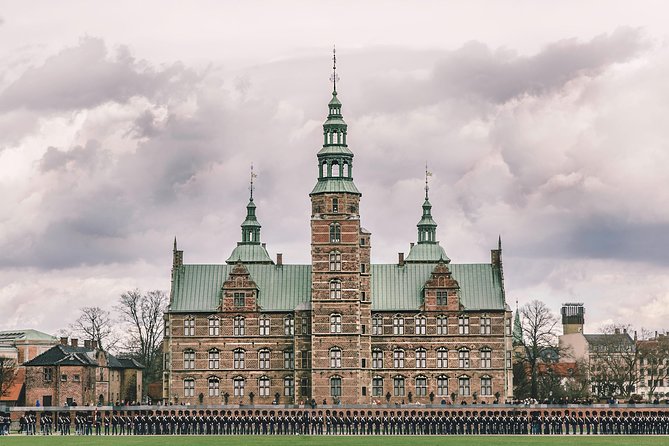
- Rosenborg Castle Dutch Renaissance exterior: the façade is said to match the day it was built
- Christiansborg in the real center of power: Folketing meets there, plus old ruins below the modern building
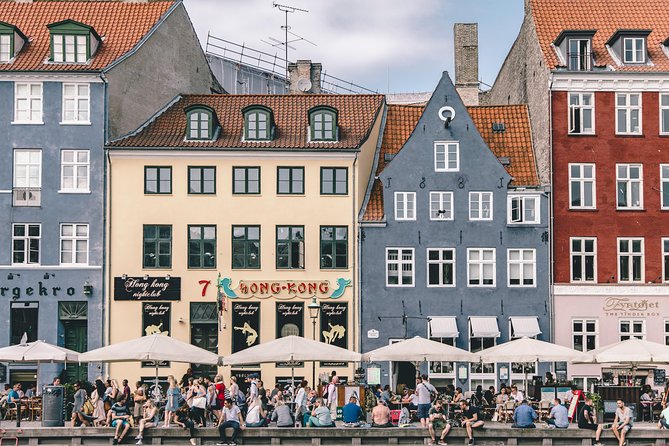
- Nyhavn waterfront with Andersen connections: a classic harbor street tied to Hans Christian Andersen
Why the Little Mermaid to Royal Castle route feels efficient
This is the kind of tour that helps you get your bearings fast in Copenhagen. You start around Banegårdspladsen and build outward, then back inward, so the city starts to make sense. In about 2 hours 30 minutes, you pass major landmarks that are often spread across multiple neighborhoods, which is exactly why this works when time is tight.
The pacing is also designed for real sightseeing, not just transit. You’ll spend time at big-ticket stops like the Little Mermaid and Rosenborg Castle, and you’ll get a real moment at the Amalienborg guard change at midday. Then the route keeps broadening: you see churches, palace fronts, bridges, and waterfront scenes, plus a couple of stops that add a more modern Copenhagen vibe.
Group size stays small enough to feel personal, with a maximum of 33 travelers. The tour also includes an audio guide, so even when the van is rolling, you get context instead of blank stares at buildings.
More of Copenhagen, reviewed one tour at a time
- Copenhagen: Canal Cruise with Guide
★ 4.6 · 9,115 reviews - Copenhagen: Hop-On Hop-Off Bus Tour with Boat Tour Option
★ 3.9 · 4,122 reviews - Private Walking Grand Tour of Copenhagen
★ 5.0 · 3,953 reviews - From Copenhagen: Lund and Malmö 2-Country Tour
★ 4.7 · 2,772 reviews
Price and timing: what your 2.5 hours costs, and why it can be good value
At $61.40 per person for roughly 2 hours 30 minutes, this is priced like a budget-friendly highlights tour. The real value is not just the sightseeing list. It is the combination of guided interpretation, transportation, and time efficiency.
If you are arriving with limited day-time, the math often favors a guided route. Copenhagen is beautiful, but it can also be spread out. Paying for a planned loop lets you spend your hours on the highlights instead of stitching together public transit or walking long distances between far-apart stops.
You also get multiple perks that matter in practice. The van is air-conditioned, there is WiFi onboard, and you receive an audio guide. Those small conveniences can lower the stress level, especially if your day includes cruise logistics or tight timing.
One more detail: the tour can run up to 3 hours. That is still workable, but it is a good reason to avoid stacking your day with a rigid second plan right after pickup.
How the tour keeps you comfortable and informed (van, audio guide, and small groups)
This tour includes an air-conditioned vehicle, WiFi onboard, and an audio guide, plus a host or driver. That combo is more useful than it sounds. When you are moving between sites like Tivoli Gardens, Rosenborg, and then the harbor area around Nyhavn, it helps to have a guide plan that keeps you oriented.
The audio guide matters most for two reasons. First, many landmarks look straightforward from the outside, but the stories are what make them stick. Second, you will hit several places quickly, so audio prevents the usual problem of remembering only the most famous postcard spots.
The group size cap of 33 is also part of the experience quality. Small groups make it easier for the guide to manage timing, especially around outdoor photo stops and the midday guard change.
If you want a tour that balances structured stops with enough freedom to look around, this is built for you. If you want hours inside museums without interruptions, you might find the pace quick.
Tivoli Gardens, sculpture museums, and Copenhagen’s plant-filled side
The morning portion starts with Tivoli Gardens, which dates back to 1843. Even if you do not go inside the amusement park, this is a good orientation moment. It signals that Copenhagen has always been about public spaces, not just grand palaces.
Next you move to an art museum focused on antique sculptures from the Mediterranean area, plus French and Danish works from the 19th century. This is a nice change of pace from the typical royal-only routes. You get a sense of how Denmark ties into broader European art currents.
Then comes a nature and science stop that many first-timers skip: Denmark’s largest plant collection at the State Natural History Museum, spread over 10 hectares. The Palm House is a highlight, and you also see works tied to Myron, including Athena and Marsyas. The route also touches the Astronomical Observatory, including the Østervold Observatory and a connection to Tycho Brahe (1546 to 1601).
This cluster makes the day feel more balanced. Copenhagen is not only castles and waterfronts. It is also scientific curiosity and public institutions. If you like variety, this part is a big win.
The trade-off is that these stops are included in a tight schedule. So if a museum is your main goal, bring patience for short moments and then plan a return visit on another day.
- Copenhagen Highlights Walking Tour★ 5.0 · 2,324 reviews
- Copenhagen: Highlights 3 Hour Bike Tour with a Local Guide★ 4.8 · 2,312 reviews
- Hamlet and Sweden Tour – Two Countries in one day !★ 5.0 · 2,223 reviews
- Grand Day Trip around Copenhagen★ 5.0 · 2,020 reviews
- Copenhagen Sightseeing Classic Canal Tour With Live Guide★ 4.5 · 1,906 reviews
Rosenborg Castle and the Little Mermaid: two icons, two different kinds of time
Rosenborg Castle is built in Dutch Renaissance style under King Christian IV, and the exterior is described as matching the day it was built. That detail matters because it frames the building as something you can read like an object with continuity. Even from outside, it gives you a clear royal-era visual anchor.
Then you shift to the waterfront at the Little Mermaid. She has been sitting on her rock since 1913. She was gifted by Carl Jacobsen of the Carlsberg Brewery, and the sculpture by Edvard Eriksen is bronze on granite. The story connection to Hans Christian Andersen is part of the experience, but the physical details are what you will notice most: the sculpture is accessible at low tide.
That low-tide note is not trivia, it is practical. If the water is higher, you might not get the same view of the rock and base. The tour stop is brief, so aim to observe carefully and do a quick check of conditions if you can.
One more thing: the route includes the Danish Resistance Museum, housed underground in a new building opened in 2020. This stop adds emotional weight to the day. The focus is life under German occupation from 1940 to 1945, with special attention on Danish resistance groups. In a tour packed with bright scenery, this underground museum gives you contrast.
Gefion Fountain, Amalienborg at midday, and the Marble Church dome
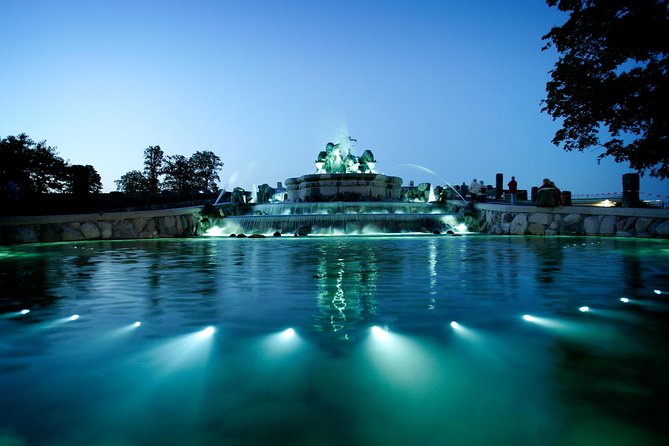
Gefion Fountain is dedicated to the goddess Gefion, linked to the story of turning sons into oxen and plowing the island of Sjælland out of earth from Sweden. It is funded by the Carlsberg Foundation, designed by Danish sculptor Anders Bundgaard (1897 to 1899), and the basin was completed in 1908, the same year the fountain was first activated.
This is a good stop for two reasons. It connects Copenhagen to myth and explains how public art can be tied directly to identity. It also acts as a visual breather before the royal core.
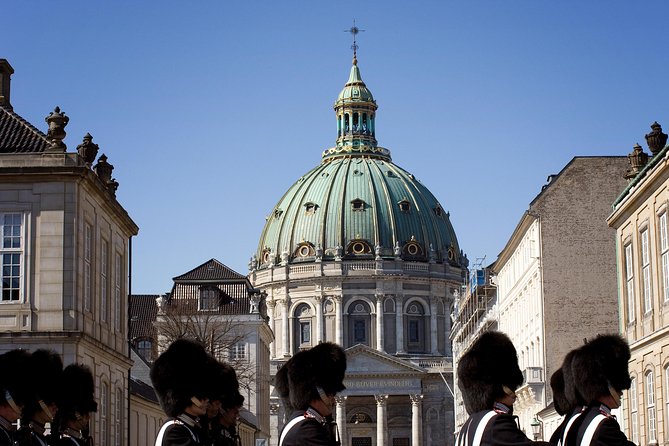
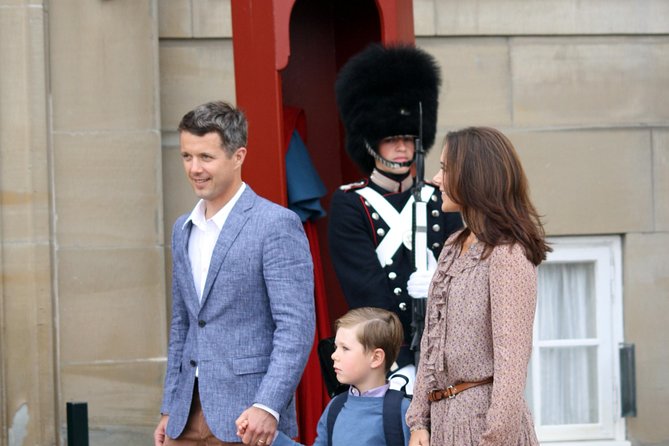
Then you reach Amalienborg Palace for the changing of the guard at midday. The palaces date back to the 1760s, with the Royal Family moving in in 1794 after Christiansborg Castle burnt down. There are four palaces there: Christian VII’s Palace, Christian VIII’s Palace, Frederik VIII’s Palace, and Christian IX’s Palace. The Life Guards take part every day at midday, and the tour lists this as a free stop.
After that, you get Frederiks Church, often called the Marble Church. It was commissioned by King Frederik V and designed by Nicolai Eigtved, with construction starting in 1740 and slowing after Eigtved died in 1754. It stopped in 1770, and later design work by Ferdinand Melhdahl finished the project. Because of a restricted budget, parts were built with limestone instead of marble. The dome is described as the third largest church dome in Europe.
If you like architecture details, this section is satisfying. You are moving from myths in stone to real daily ceremony to a major church dome, all within one guided flow.
Christiansborg, Thorvaldsen’s grave, Operaen photos, and Børsen dragons
Christiansborg is where the Danish parliament, Folketing, meets. The present building dates back to 1928, and below it you can see ruins from the first Copenhagen Castle built in 1167 by Bishop Absalon. The first Christiansborg Palace was built by King Christian VI in 1740. Later, Christiansborg’s roof caught fire in 1992, with repairs completed by 1997. The tour also notes King Frederik X’s throne and that he waved from the balcony during his installation by Prime Minister Mette Frederiksen, and that Denmark has no coronations.
In plain terms, this stop is about power and layers. You are looking at a modern seat of government, with older ruins under your feet. It is a strong contrast to the more decorative palaces you see elsewhere.
From there, you move toward a canal area tied to Bertel Thorvaldsen, the neoclassical sculptor. The route includes a museum by the canal where you can visit Thorvaldsen’s grave.
Then there is a quick stop at Det Kongelige Teater, Operaen. It is listed as a free stop and focuses on photos, including views of Copenhagen harbor and Amalienborg Palace.
You will also pass the equestrian statue of Bishop Absalon from 1902, then Børsen, the old Stock Exchange building from the 1620s built by King Christian IV. The spire above Børsen is made of intertwined dragons tails, and it functioned as a stock exchange right up into the 1800s.
If you enjoy noticing details, this stretch rewards you. You go from political drama to sculptor legacy to dragons made of stone.
Christianshavn to Nyhavn: canals, Holmens Church, the Black Diamond, Langebro, and Andersen’s harbor
The route continues into Christianshavn, with views overlooking the canal and Our Saviour’s Church. This area is especially photogenic because the canal framing makes Copenhagen feel slower and more local.
Next is a stop at an 18th-century mansion with collections and exhibitions about Denmark’s history, its people, and culture. Then you move to the Danish National Gallery for international collections and temporary exhibitions, plus children’s activities. Even if you do not spend long inside, these stops signal something helpful for your planning: Copenhagen’s museum scene is not one-style, one-mood. It ranges from national identity to international art.
Then you reach Holmens Church, built in 1619 in a former anchor forge by King Christian IV. It is both a parish church and the church used by Denmark’s Royal Navy. It is also described as being near sea water, and inside you can see models of ships hanging from the ceiling. That naval connection is a strong touch in a city built on waterways.
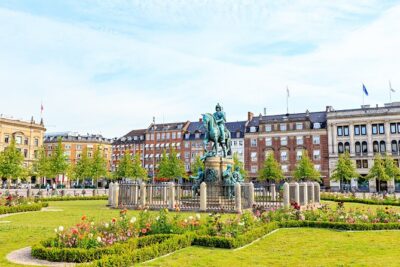
Kongens Nytorv comes next, commissioned in 1670 by King Christian V and inspired by Place d’Vendôme in Paris. The statue in the middle is Christian V, placed there in 1688, and it is described as the oldest royal statue in Copenhagen. The Royal Theatre and the Royal Academy of Arts are housed in the former Charlottenborg Palace around this square.
Then you get a modern Copenhagen moment at the Black Diamond, the extension of the Royal Danish Library. It opened in 1999, is built of black granite from Zimbabwe, and connects by bridge to the main library building from 1906. It includes a reading room, a music room, plus a cafe and bookshop.
After that, Langebro appears: a bridge that opens for large ships. Built in 1954, designed by Kaj Gottlob, it is 7 meters high and 35 meters long. The tour also notes repairs started in 2019 due to rainwater damage, with a cost estimate of 307 million Kroner, about €40 million.
Finally, you land in Nyhavn. It was built between 1671 and 1673 by Swedish prisoner of war workers. The oldest house in Nyhavn is Nyhavn 9 from 1681. Hans Christian Andersen lived in Nyhavn at different times in numbers 18, 20, and 67. At the end of Nyhavn, there is a memorial anchor placed in 1951 for Danish merchant seamen lost in World War II. Today, the area is full of restaurants and pavement cafes after renovation in the 1980s.
This last stretch is the payoff. You go from royal power and stone dragons to libraries, openable bridges, and a waterfront street tied to Andersen and seafaring memory.
Who should book this tour, and who should skip it
This works best for you if you are a first-time visitor or you have a limited window. The route is packed but not frantic, and the midday guard change at Amalienborg gives it a real schedule anchor. It is also a smart option if you are planning around a cruise or a tight transport deadline, since the vehicle moves you between areas without you having to plan each hop.
I would skip it or reduce expectations if you are museum-first. Some stops are short photo breaks, and you are not getting a long indoor immersion at every location. Also, lunch is not included, so plan a meal either before or after.
If you are deciding between doing Copenhagen on your own and doing it guided, this tour is a practical way to pick up the city quickly. You get a tour route that covers Tivoli, Rosenborg, the Little Mermaid, multiple royal sites, the harbor, and Nyhavn in about one morning.
FAQ
How long is the Grand Tour of Copenhagen?
The tour runs about 2 hours 30 minutes, and it can take up to 3 hours.
What is the price per person?
The price is $61.40 per person.
Is pickup available?
Yes, pickup is offered.
What time and where does the tour start?
It starts at 9:30 am from Banegårdspladsen 2, 1570 København, Denmark.
How many people are in the group?
The tour has a maximum of 33 travelers.
What’s included in the tour price?
Included are an air-conditioned vehicle, WiFi on board, an audio-guide, and a host or driver.
Is lunch included?
No, lunch is not included.
Do I need to print tickets?
You get a mobile ticket.
Which stops are part of the route?
The highlights include Tivoli Gardens, Rosenborg Castle, the Little Mermaid, the Danish Resistance Museum, Gefion Fountain, Amalienborg changing of the guard, Frederiks Church, Christiansborg, Thorvaldsen’s grave area, Operaen, Børsen, Christianshavn, museums and galleries, Holmens Church, Kongens Nytorv, the Black Diamond, Langebro, and Nyhavn.
Can I cancel for free?
Yes. You can cancel for free up to 24 hours in advance for a full refund.
Should you book this Copenhagen highlights tour?
If you want a single morning that strings together the biggest Copenhagen sights with real context, book it. The value is in the guided pacing, the transportation, and the mix of royal landmarks plus waterfront Copenhagen, all within about 2.5 hours.
Book with a heads-up mindset if you want long museum time or you hate quick photo stops. Also, if you care about an ideal view of the Little Mermaid, consider planning your day with the low-tide detail in mind.
More Tours Around Denmark
All Our Denmark Reviews
Copenhagen, Reviewed
Other Danish days out we have written up



Copenhagen Tours, compared.
 ★ 4.6Canal Cruise with GuideFrom $269,115 reviews
 ★ 3.9Hop-On Hop-Off Bus Tour with Boat Tour OptionFrom $354,122 reviews
 ★ 5.0Private Walking Grand Tour of CopenhagenFrom $3423,953 reviews
 ★ 4.7From Copenhagen: Lund and Malmö 2-Country TourFrom $1412,772 reviews
 ★ 5.0Copenhagen Highlights Walking TourFrom $402,324 reviews
 ★ 4.8Highlights 3 Hour Bike Tour with a Local GuideFrom $622,312 reviews
 ★ 5.0Grand Day Trip around CopenhagenFrom $2112,020 reviews
 ★ 4.5Copenhagen Sightseeing Classic Canal Tour With Live GuideFrom $331,906 reviews